
L-Shaped Desks: The Complete Buying Guide
L-shaped desks compared by size band, material, and price. Learn compact vs standard vs executive sizing, left vs right orientation, and who actually needs the extra surface.
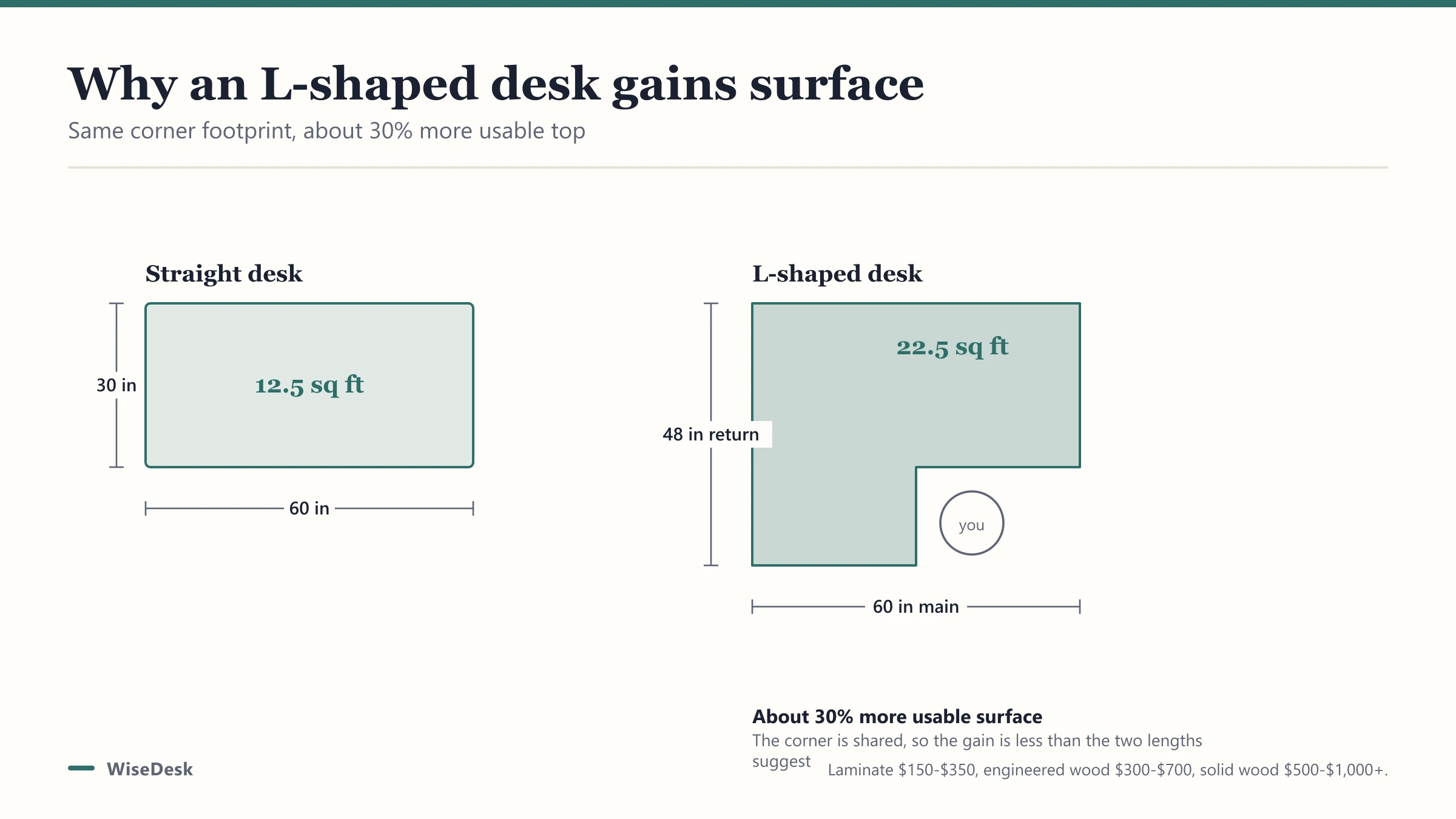
An L-shaped desk turns a room corner into usable work surface instead of dead space. It is the default recommendation for anyone running dual monitors, a gaming rig with a separate console area, or a job that mixes screen work with paperwork, because a straight desk simply runs out of room first.
What is an L-shaped desk?
An L-shaped desk is two connected work surfaces meeting at a 90-degree corner, typically a long main surface plus a shorter “return” that extends perpendicular to it. The corner join is what separates it from simply pushing two desks together: L-shaped desks are built as one unit with a shared or matched frame, so the two surfaces sit level and stay stable.
The extra surface is the entire appeal. A straight 60-inch desk gives you 60 inches of usable width; an L-shaped desk with a 60-inch main wing and a 48-inch return gives you both, arranged around a corner instead of stretched along one wall.
What sizes do L-shaped desks come in?
L-shaped desks are sold in three broad size bands, measured by the long side:
- Compact: under 55 inches on the long side. Fits apartments and small bedrooms; see our small and corner L-shaped desk picks if this is your band.
- Standard: 60 to 71 inches on the long side. The most common size for a home office with room to spare.
- Executive/Large: 72 inches or more, often paired with a hutch shelf above the return. Built for dedicated offices, not shared rooms.
Match the band to your corner measurement first, not to the desk that looks biggest in photos. An executive desk in a small bedroom eats the walking space around it.
Left-facing or right-facing, and does it matter?
L-shaped desks are sold as left-facing or right-facing, describing which side the return sits on when you’re seated at the main wing. Pick based on your room layout (which wall the corner sits against) and, secondarily, which hand you write or reach with most, since the return is where a lot of people keep a notepad, a second monitor, or a printer.
Some desks ship reversible, with mounting holes on both sides so you can flip the return later. If your room layout might change, that flexibility is worth checking for before you buy.
What are L-shaped desks made of, and what do they cost?
Material tracks price closely, and price roughly follows the same tiers as any other desk:
| Material | Typical price band | Notes |
|---|---|---|
| Laminate/particleboard | $150-$350 | Lightest, most affordable, least durable long-term |
| Engineered wood or bamboo | $300-$700 | Better surface feel, holds up to daily use |
| Solid wood | $500-$1,000+ | Heaviest, most durable, premium look |
| Electric sit-stand L-shape | $600-$1,300+ | Adds motorized height adjustment to any material tier above |
A named example at the premium end is the Desky Bamboo L-shape sit-stand desk, which pairs a bamboo top with dual-motor height adjustment. Check the current listing for exact specs, since manufacturers update models.
Do you need a standing L-shaped desk?
Only if you already know you want to alternate sitting and standing at your primary desk. An electric L-shaped standing desk costs more than a fixed one, roughly the same premium a straight standing desk carries over a straight fixed desk, because both wings need to move together. If you’re unsure, our riser desk guide covers a cheaper way to test standing work before committing to a full L-shaped standing setup.
If you have decided standing is worth it, our best L-shaped standing desks list compares models across all three size bands.
Do you need drawers or a hutch?
If your job involves paper, a hutch or a set of drawers under the return keeps supplies off the main surface. Our L-shaped desks with drawers and hutch storage guide covers the storage-focused picks specifically, since not every L-shaped desk includes built-in storage by default.
How long does assembly take?
Budget it more time than a straight desk. A compact L-shaped desk with a laminate top and basic legs typically takes 45 minutes to an hour for one person with a power drill. Standard and executive sizes, especially with a hutch or drawer pedestal, commonly run two to three hours and go faster with a second person, since aligning the corner join while holding both wings level is awkward alone.
Check the box weight before assuming you can move it yourself. A standard-size solid wood L-shaped desk in its shipping box can weigh well over 100 pounds, and many delivery services leave it at the door rather than carrying it in. If stairs are involved, factor that into whether you need help on delivery day, not just for assembly.
Pre-drilled holes and cam-lock hardware, common on mid and premium desks, cut assembly time noticeably compared to desks that require you to drill your own pilot holes. It’s worth checking product reviews specifically for assembly complaints before buying, since this varies more by manufacturer than by price tier alone.
Who should NOT buy an L-shaped desk?
- Anyone in a room without a real corner to use. A desk pushed into an open floor plan loses the space-saving advantage entirely.
- Frequent movers. L-shaped desks are heavier and harder to disassemble and reassemble than a straight desk.
- Single-monitor minimalists. If your setup is one screen and a laptop, the extra surface mostly collects clutter.
- Anyone on a tight budget who only needs standing, not surface area. A straight standing desk or a riser desk solves the height problem for less money.
Once you have picked a size band and material, the next decision is shape-specific: gaming setups, small rooms, and storage-heavy jobs each pull toward a different L-shaped desk, and the guides linked above sort by exactly those use cases.
Frequently asked questions
Quick answers to what readers ask us most
What is the point of an L-shaped desk over a straight desk?
Surface area without needing more floor space in one direction. An L-shaped desk uses a room corner, so you get a second full work surface (for a second monitor, a printer, or paperwork) without the desk sticking further into the room.
Left-facing or right-facing L-shaped desk, does it matter?
It only matters for your room layout and which hand you write with. Left-facing means the return sits on your left when you face the desk; right-facing is the mirror image. Most brands sell both, and some are reversible.
Can an L-shaped desk be a standing desk?
Yes. Electric L-shaped standing desks exist at every size band, though they cost more than a fixed L-shaped desk because both wings need motorized legs or a shared frame. See our best L-shaped standing desks list.
How much space does an L-shaped desk need?
A compact L-shaped desk fits in roughly a 5 by 5 foot corner; standard and executive sizes need closer to 6 by 6 feet once you account for chair clearance behind you. Measure your corner before ordering, since returns on large desks are expensive to ship back.