
7 Real Benefits of a Standing Desk (Backed by Data)
What a standing desk actually changes: back pain, energy, posture variation, and calorie burn, sorted from strongly supported to marketing hype.
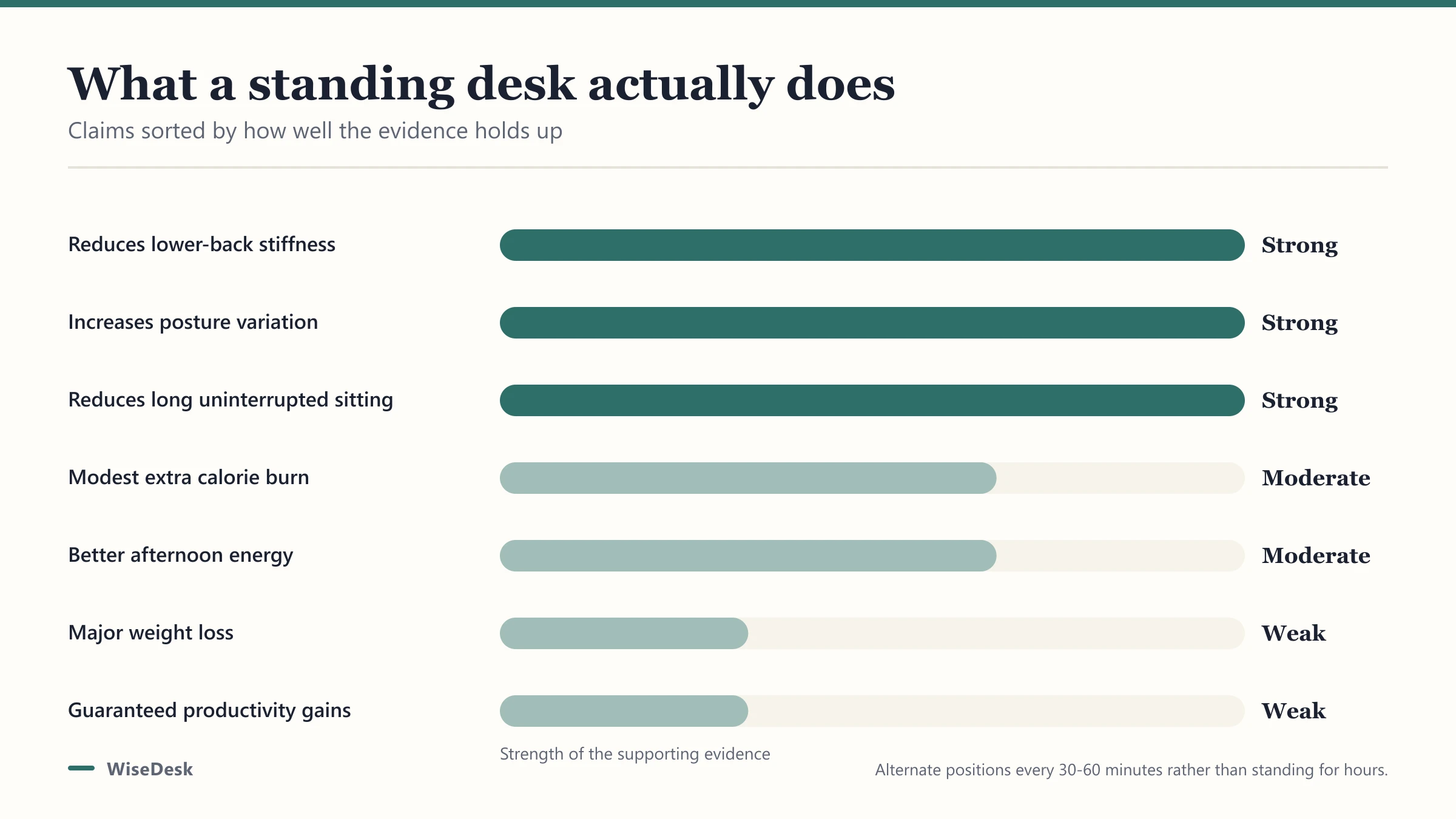
Standing desks get sold with big promises, and not all of them hold up equally. Here’s what switching to a sit-stand routine actually changes, ranked from the claims with solid support down to the ones that are more marketing than mechanism.
1. Less lower-back stiffness
This is the benefit with the most consistent backing. Sitting in one position for hours compresses spinal discs and shortens hip flexors; alternating with standing periods relieves that static load and is the single most commonly reported improvement among people who switch to a sit-stand desk.
The catch: standing at the wrong height creates its own strain. Get your target number from our desk height calculator before assuming a standing desk alone will fix back pain.
2. More posture variation through the day
A standing desk’s real mechanism isn’t standing itself, it’s variation. Alternating positions every 30 to 60 minutes keeps blood moving and prevents any single posture from becoming a sustained strain, which is a more defensible claim than “standing is healthier than sitting” on its own.
This is also why a fixed-height desk plus occasional stretching breaks gets you partway to the same benefit, just less conveniently than pressing a button or using a riser desk.
3. Reduced uninterrupted sitting time
Researchers studying sedentary behavior consistently flag long uninterrupted sitting stretches, not sitting itself, as the higher-risk pattern. A standing desk breaks up those stretches automatically, since raising the desk forces a position change you’d otherwise have to remember to make.
4. A modest bump in daily calorie burn
Standing burns more calories than sitting, but the gap is smaller than marketing implies, roughly the difference of a short walk spread across a workday. It’s a real, measurable effect, just not one that replaces diet or exercise as a weight-management strategy.
5. Better afternoon energy for many users
Commonly self-reported, harder to measure precisely: people who alternate positions often describe feeling less sluggish in the mid-afternoon than when sitting the entire day. Movement and posture change plausibly play a role, though individual results vary more here than with the back-pain benefit.
6. Fewer blood sugar and circulation complaints
Extended static sitting is linked to poorer circulation and blood sugar regulation in general health guidance. Standing periods interrupt that static state. This benefit sits closer to “supported by general sedentary-behavior research” than to a standing-desk-specific clinical claim, but it’s a real reason clinicians recommend movement breaks regardless of desk type.
7. A cleaner ergonomic baseline
A sit-stand desk forces you to actually think about monitor height, keyboard position, and desk height, since those numbers now need to work at two heights instead of one. That process alone often fixes ergonomic mistakes that had been quietly causing strain at a fixed desk. Our ergonomic desk setup guide covers getting all three numbers right.
What standing desks do NOT reliably fix
| Claim | Evidence strength |
|---|---|
| Reduces lower-back stiffness | Strong, most consistently reported |
| Increases posture variation | Strong, direct mechanism |
| Reduces long uninterrupted sitting | Strong, matches general sedentary-behavior guidance |
| Modest extra calorie burn | Moderate, real but small |
| Better afternoon energy | Moderate, self-reported |
| Major weight loss | Weak, requires diet/exercise too |
| Guaranteed productivity gains | Weak, depends on the individual |
How much standing time is actually enough?
There’s no single magic number, but general guidance from sedentary-behavior research points toward alternating positions every 30 to 60 minutes rather than standing continuously for hours. A common starting pattern is a rough 1:1 or 1:2 ratio of standing to sitting across the workday, built up gradually rather than switching to standing all at once.
Jumping straight to standing for a full 8-hour day is a common mistake that backfires. New standing desk users who overdo it in the first week often end up with sore feet and legs, which then gets blamed on the desk itself rather than the pacing. A more realistic ramp-up is 30 to 45 minutes of standing per hour in week one, increasing gradually as your legs adjust.
Some people find a simple timer or a reminder app more useful than trying to remember on their own, especially in the first month of switching to a sit-stand routine. Once alternating becomes a habit, most people stop needing the reminder.
Do you need data to justify buying one?
Not really. The strongest, most consistently supported benefits (less stiffness, more posture variation, less uninterrupted sitting time) come from mechanisms that are well understood even without a personal before-and-after measurement: changing position regularly reduces static load on your spine and improves circulation, regardless of which specific desk brand or price tier you buy. The desk itself is just the tool that makes switching positions easy enough to actually do consistently.
Who benefits least from a standing desk?
Anyone who buys one and then stands continuously without alternating loses most of the benefit and adds foot and leg fatigue instead. The same goes for anyone who sets it up once at the wrong height and never adjusts it. If your desk starts giving you trouble mechanically rather than posturally, our standing desk troubleshooting guide covers the most common fixes.
The honest takeaway: a standing desk is a tool for posture variation, not a health fix on its own. Used with real alternation and the right height, the back-pain and stiffness benefits are worth chasing; used as a novelty that sits at one height all day, it does almost nothing a normal desk wouldn’t.
Frequently asked questions
Quick answers to what readers ask us most
Does a standing desk help you lose weight?
Only modestly. Standing burns more calories than sitting, but the difference over a workday is small compared to diet or exercise. Treat it as a minor add-on to activity, not a weight-loss strategy on its own.
Does standing all day hurt your legs and feet?
Yes, if you stand continuously without breaks. The benefit comes from alternating sitting and standing, not from replacing one static posture with another; most guidance suggests standing for stretches of 30 to 60 minutes rather than all day.
How long before you feel the benefits of a standing desk?
Reduced stiffness and better afternoon energy are commonly reported within the first one to two weeks, once your legs adjust to the new routine. Posture and back-pain benefits build over longer, consistent use.
Do you need an electric standing desk to get these benefits?
No. A manual crank desk or a riser desk gives the same postural benefit as an electric model; the only trade-off is how quickly and often you're willing to switch positions.