
Riser Desk vs Standing Desk: Which Do You Need?
Riser desk or full standing desk? Compare price, height range, stability, and surface space to find the right pick for your budget and room.
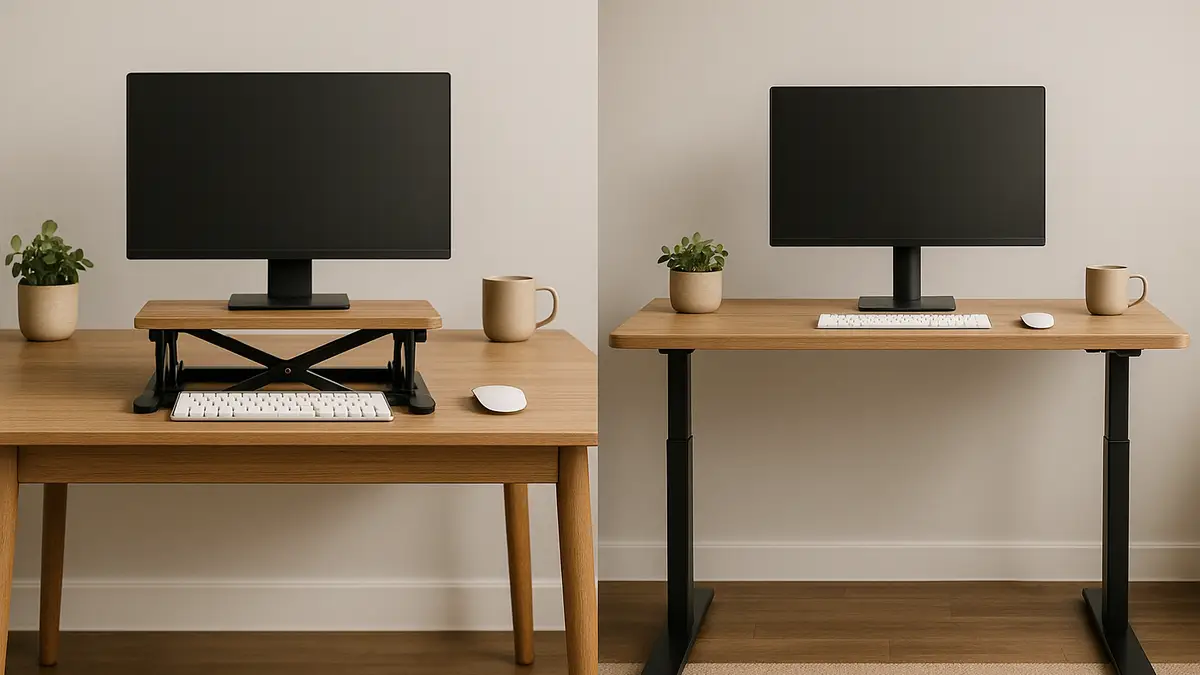
Both a riser desk and a full standing desk get you the same core result, a desk that changes height, but they get there in very different ways and at very different prices. Here’s the actual trade-off, not just the marketing pitch for either one.
What is the core difference?
A riser desk is a converter that sits on top of a desk you already own; a standing desk is a complete desk with motorized or manual-crank legs built in. Our riser desk guide covers the converter in full detail; this page focuses on choosing between the two.
Head-to-head comparison
| Factor | Riser desk | Full standing desk |
|---|---|---|
| Price | $80-$500 | $150-$1,300+ |
| Height range added | 15.5-20 in above existing surface | 22.5-48 in travel (25.3-50.9 in premium) |
| Setup | Sits on top of current desk, minutes to place | Full desk assembly, an hour or more |
| Surface at standing | Split across two tiers, smaller | One flat surface, full desktop size |
| Stability at full height | Varies, weaker on single-tier budget models | Generally more stable, legs bear weight directly |
| Portability | Easy to move or store | Heavy, not meant to relocate often |
| Best for | Renters, testing standing work, tight budgets | Daily standing use, permanent home office |
Which one costs less?
The riser desk, clearly, at every tier. Budget converters start around $80, while even a budget full standing desk frame starts near $150 and climbs fast with motor count and weight capacity. If cost is the deciding factor and you’re not sure standing work suits you yet, start with a riser desk or check our standing desks under $300 picks if you’ve already decided to go with a full desk on a budget.
Which one gives you more usable space?
The full standing desk. A riser desk splits your work surface into a lower keyboard tier and an upper monitor tier, which works fine for a single monitor and keyboard but gets tight fast with dual monitors, a laptop stand, and notebooks all competing for the same small platform. A full standing desk keeps one continuous surface at whatever height you set it.
Which one is more stable?
Generally the full standing desk, because its legs bear weight directly on the floor rather than balancing a converter on top of another piece of furniture. That said, stability on a riser desk varies enormously by build quality: a cheap single-tier converter wobbles noticeably at full extension, while a dual-tier steel-frame model with a real weight rating holds steady. If a riser is still your pick, check our best standing desk converters for models that tested steady.
Which one is faster to adjust?
A full electric standing desk generally wins here. Standard-tier motors move at 1 to 1.5 inches per second, and premium motors reach 1.5 to 2.3 inches per second, covering the full sit-to-stand range in under a minute either way. A manual crank riser desk is noticeably slower, often 15 to 30 seconds of active cranking, while an electric riser desk closes most of that gap since it uses a similar motor-and-button mechanism, just over a shorter travel range.
If you plan to switch positions several times a day, the adjustment speed adds up. A slow manual crank is the kind of friction that quietly discourages you from actually alternating, which undercuts the whole point of a sit-stand setup.
What about long-term durability?
A full standing desk generally holds up better over years of daily use, since its legs are engineered as a complete adjustable system rather than a converter balanced on top of separate furniture. Riser desks, especially budget single-tier models, see more wear at the pivot points that raise and lower the platform, simply because that mechanism is doing double duty: supporting weight and moving through a shorter, more frequently used range.
That said, a well-built dual-tier riser desk from a reputable brand can last just as long as a mid-tier standing desk frame; durability tracks build quality within each category more than it tracks the category itself.
Which one should you actually buy?
Buy a riser desk if any of these apply: you rent and can’t swap furniture, you’re not sure you’ll use standing work daily, or your budget is under $300. It’s the lower-risk purchase and the one most people should start with.
Buy a full standing desk if you already know you’ll stand for real stretches of the day, you need the full desktop surface for dual monitors or paperwork, or you’re setting up a permanent home office rather than a temporary or shared space.
A middle path exists too: a DIY standing desk built with adjustable legs gives you full-surface flexibility for close to converter money, if you don’t mind the weekend build.
Who should NOT buy either one yet?
Anyone who hasn’t measured their target height. Both options fail if the range doesn’t match your body: a riser desk on a too-tall existing desk can push a short user’s monitor above eye level, and a full standing desk’s travel range needs to reach your specific standing elbow height. Run your numbers through the desk height calculator before buying either.
Anyone who has never tried standing work at all should also start with the cheaper option. A riser desk answers the “will I actually use this” question for a fraction of the cost of finding out the hard way with a full desk purchase.
Frequently asked questions
Quick answers to what readers ask us most
Is a riser desk worth it if I might buy a standing desk later?
Yes, for most people. A riser desk costs a fraction of a full desk and answers the real question, whether you'll actually use a standing setup daily, before you spend more. Many riser desk owners keep using the converter for years without ever upgrading.
Which one has more usable desk surface?
A full standing desk, by a wide margin, since the entire desktop moves as one flat surface. A riser desk's two-tier design splits your surface into a keyboard shelf and a smaller monitor platform, which feels cramped for anyone running dual monitors.
Can I put a riser desk on top of a standing desk?
You can, but it's redundant and usually a mistake. It stacks the riser's 15.5 to 20 inch range on top of a desk that already travels 22.5 to 48 inches, pushing your monitor higher than most people need and wasting the money spent on the adjustable frame.
Which is more stable at full height?
A full standing desk, since its legs bear weight directly rather than a converter perched on a separate desk surface. Cheap single-tier riser desks are the most common source of wobble complaints; a dual-tier steel-frame converter closes most of that gap. See our best standing desk converters list for steadier options.